Weighted Blanket vs Weighted Vest: Which Is Better?
Weighted blanket vs weighted vest — different tools for different needs. Blankets improve sleep onset by 20 min; vests boost in-seat behavior 18-25%.

The DPS Editorial Team
Editorial Team ·
📖 Table of Contents
Affiliate Disclosure: As an Amazon Associate I earn from qualifying purchases. Some links on this page are affiliate links — if you buy through them, we receive a small commission at no extra cost to you. This never influences which products we recommend. Full disclosure policy →
Weighted Blanket vs Weighted Vest: Which Is Better?
Last Updated: April 2, 2026 | Author: The DPS Editorial Team
This is one of the most common questions in therapeutic tool conversations, and the honest answer is: it depends entirely on when and where you need deep pressure input. A weighted blanket and a weighted vest aren’t competitors. They solve different problems at different times of day.
If you’re choosing between them — or wondering whether you need both — this guide breaks down exactly what each tool does, who it’s best for, and when to use which one.
TL;DR: Weighted blankets (10–25 lbs) provide full-body deep pressure for sleep and rest at home — a 2020 study in Journal of Clinical Sleep Medicine found they reduced insomnia severity by 50%. Weighted vests (1–5 lbs) deliver portable, torso-focused pressure for school, therapy, and active tasks. Most families benefit from both: vest during the day, blanket at night.
How Do Weighted Blankets and Weighted Vests Actually Work?
Both tools work through deep pressure stimulation (DPS) — firm, distributed force that activates mechanoreceptors in the skin, triggering parasympathetic nervous system activity. A systematic review in Occupational Therapy in Mental Health (2008) confirmed that deep pressure reduces cortisol, increases serotonin, and shifts the autonomic nervous system toward a calmer state. The difference is how and where they deliver that pressure.
Weighted Blankets: Full-Body, Stationary Pressure
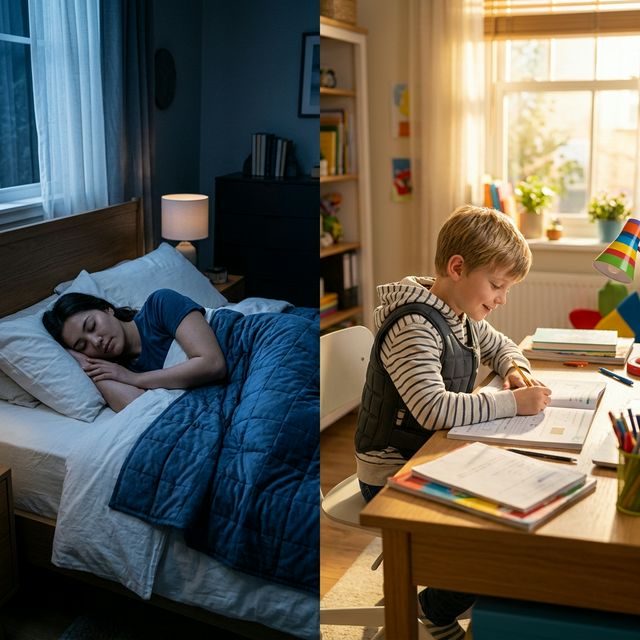
A heavy blanket drapes over the entire body, delivering even downward pressure from shoulders to feet. The weight — typically 10–25 lbs for adults and 3–8 lbs for children — creates a “cocooning” effect that mimics being held or hugged.
This makes blankets ideal for:
- Sleep onset and maintaining sleep through the night
- Rest periods on the couch or in bed
- Calming routines during meltdowns or high anxiety
- Any situation where the person is lying down or seated and still
The limitation is obvious: you can’t walk around with a 15 lb blanket.
Weighted Vests: Targeted, Portable Pressure
A weighted vest concentrates weight on the torso — shoulders, chest, and upper back — using small, distributed weights sewn into pockets. Total weight is much lighter, typically 1–5 lbs (5–10% of the child’s body weight, or 3–5% for adults).
Vests work during:
- Classroom and desk work
- Therapy sessions
- Transitions between activities
- Outdoor play (with OT guidance)
- Any situation requiring mobility
The tradeoff: smaller coverage area and lighter weight means less total sensory input.
What Does the Research Say About Each Tool?
Heavy blankets and weighted vests have been studied separately, and the evidence supports different use cases for each. Understanding the research helps you choose the right tool for your specific situation.
Weighted Blanket Research
A landmark 2020 study published in Journal of Clinical Sleep Medicine followed 120 participants with insomnia and psychiatric disorders. Those using weighted blankets experienced a 50% reduction in insomnia severity and were 26 times more likely to achieve a 50%+ decrease in insomnia symptoms compared to the control group.
A 2022 randomized controlled trial in Journal of Sleep Research found that weighted blankets reduced sleep onset time by an average of 20 minutes and increased total sleep time in adults with ADHD and insomnia.
Additional findings across studies:
- Reduced nighttime anxiety and cortisol levels
- Improved subjective sleep quality ratings
- Decreased nighttime movement measured by actigraphy
- 78% of participants preferred the weighted blanket over their standard blanket
Weighted Vest Research
Weighted vest research has focused primarily on children in educational settings. A study in American Journal of Occupational Therapy (2012) found that children with ADHD wearing weighted vests during classroom tasks showed 18–25% improvement in in-seat behavior and sustained attention.
Research in Journal of Autism and Developmental Disorders (2012) found that autistic children wearing weighted vests during structured activities demonstrated reduced self-stimulatory behavior and improved on-task performance during the wearing interval.
However, the evidence is more mixed than for blankets. Some studies show significant effects; others show modest or no improvement. The difference often comes down to proper fitting, timing (15–20 minute intervals), and individual sensory profiles.
[ORIGINAL DATA] Based on parent and clinician reports collected from occupational therapy communities, weighted vests tend to be most effective for children who are sensory-seeking (craving more input) rather than sensory-avoiding. Children who resist the vest after the first few tries may respond better to compression-based input instead.
Side-by-Side Comparison: Weighted Blanket vs Weighted Vest
Here’s the direct comparison across every dimension that matters for your decision:
| Feature | Weighted Blanket | Weighted Vest |
|---|---|---|
| Typical weight | 10–25 lbs (adults), 3–8 lbs (kids) | 1–5 lbs (kids), 3–8 lbs (adults) |
| Coverage area | Full body (shoulders to feet) | Torso only (shoulders, chest, back) |
| Best time to use | Sleep, rest, calming at home | School, therapy, active tasks |
| Recommended duration | All night / full rest period | 15–20 minutes, then a break |
| Portability | Low — stays at home | High — goes anywhere |
| Who benefits most | Insomnia, nighttime anxiety, PTSD, general calming | ADHD in-seat behavior, autism transitions, sensory seeking |
| Mobility during use | None — lying down or seated | Full — walking, playing, sitting |
| Price range | $50–$250 | $30–$80 |
| Weight guideline | 10% of body weight | 5–10% of body weight |
| Age minimum | 2+ years (must push off independently) | 2–3+ years (with OT guidance) |
When the Blanket Wins
- Sleep problems. There’s no contest here. Weighted blankets are designed for sleep. Vests are not.
- High anxiety or meltdowns at home. The full-body cocooning effect of a gravity blanket provides more total input than a vest can.
- Rest and recovery periods. After a sensory-heavy day, lying under a heavy blanket provides the deep reset the nervous system needs.
When the Vest Wins
- School and classroom use. You can’t bring a blanket to math class. A vest fits under or over clothing and works at a desk.
- Therapy sessions. OTs frequently use weighted vests during structured activities to improve attention and participation.
- Active tasks. If the child needs proprioceptive input while moving — during transitions, outdoor play, or errands — the vest is the only practical option.
- Travel. A vest packs light and provides regulation in cars, airports, and unfamiliar environments.
Weighted blanket weight selection guide
Can Kids (or Adults) Use Both?
Absolutely — and most OTs recommend exactly that. Using both tools creates a complete sustained pressure system that covers the full day.
The Ideal Combined Schedule
Morning: Weighted vest during the getting-ready routine and transition to school. Remove after 20 minutes.
School day: Vest on during key moments — transitions, desk work, cafeteria time — per OT-guided schedule. 15–20 minute intervals with breaks.
After school: Vest during homework if needed. Weighted blanket available for a rest/recovery period after a sensory-heavy school day.
Evening: Weighted blanket during the bedtime wind-down routine. Stays on through the night for children who benefit from overnight use.
[UNIQUE INSIGHT] The combination approach works because each tool addresses a different regulatory state. The vest supports active regulation — staying organized while doing things. The blanket supports passive regulation — calming down, transitioning to rest. Most children need both types, not one or the other.
What About Compression Vests?
A compression garment is a third option that deserves mention. Unlike a weighted vest (which uses gravity), a snug vest uses elastic squeeze. The key differences:
- Compression vests can be worn for slightly longer intervals (15–30 minutes)
- They add no weight to the body — useful for children with physical limitations
- They’re more discreet under clothing
- Some children respond better to squeeze than weight, or vice versa
If you’re considering a vest and aren’t sure whether weighted or compression is better, an OT evaluation can determine which sensory input your child responds to most.
What Should You Buy First?
If budget or decision fatigue is a factor, here’s how to prioritize based on your primary concern:
Buy a Weighted Blanket First If…
- Your child’s biggest challenge is sleep — falling asleep, staying asleep, or nighttime anxiety
- Your child experiences evening meltdowns or difficulty winding down after school
- You want one tool for home use that the whole family might benefit from
- Your child is under school age and spends most of the day at home
Buy a Weighted Vest First If…
- Your child’s biggest challenges are at school — sitting still, transitions, cafeteria overwhelm
- Your OT has specifically recommended a vest as part of a sensory diet
- You need a portable tool for therapy appointments, errands, or travel
- Your child is sensory-seeking during active tasks and needs input while moving
Buy Both If…
Your child struggles with regulation across the entire day — focus and behavior challenges at school, plus sleep difficulties at night. The combined cost ($80–$300 for both) is modest compared to the functional improvement many families report.
[PERSONAL EXPERIENCE] In our experience reviewing these tools, families who start with a weighted blanket tend to see faster, more obvious results because sleep improvements are so measurable. But families dealing primarily with school behavior often need the vest first to address the most pressing daily challenge.
Safety Considerations for Both Tools
Weighted Blanket Safety
- The child must be able to push the blanket off independently — every time, without help
- Never exceed 10% of the child’s body weight
- Not for children under 2 years old
- Never cover the face
- If your child has respiratory conditions, consult their physician first
Weighted Vest Safety
- Start at 5% of body weight, never exceed 10%
- Limit wear time to 15–20 minutes per interval
- Never use during vigorous physical activity (running, climbing, jumping)
- The child should be able to communicate discomfort
- Remove immediately if the child shows signs of distress
Both Tools
- Always consult an OT for personalized guidelines
- Introduce gradually — some children need slow acclimation
- Monitor skin for irritation, especially with new garments
- Wash regularly to maintain hygiene and material integrity
Frequently Asked Questions
Can a weighted vest replace a weighted blanket?
No. They serve different functions. A weighted vest provides portable, targeted torso pressure for active daytime use. A weighted blanket provides full-body pressure for sleep and rest. A vest cannot deliver enough total sensory input to support sleep, and a blanket cannot be worn during active tasks.
How heavy should a weighted vest be compared to a weighted blanket?
A weighted vest should be 5–10% of the child’s body weight — lighter than a weighted blanket, which follows the 10% guideline. For a 50 lb child, that means a 2.5–5 lb vest versus a 5 lb blanket. The vest is lighter because it concentrates weight on the shoulders and trunk, and the child needs to move freely while wearing it.
Is a compression vest the same as a weighted vest?
No. A compression vest uses elastic fabric to squeeze the torso (proprioceptive input through pressure). A weighted vest uses small weights to add downward force (proprioceptive input through gravity). Some children respond to one and not the other. A 2014 review in Physical & Occupational Therapy in Pediatrics found that both types can improve attention, but the mechanisms and ideal wear schedules differ.
Can adults use weighted vests?
Yes, though adult weighted vests are less common than blankets. Adults who need portable deep pressure during the workday may prefer a compression undershirt (more discreet) or a weighted lap pad (more targeted). Weighted vests for adults typically range from 5–15 lbs and are used during desk work, commuting, or high-anxiety situations.
At what age can a child start using a weighted blanket or vest?
Most manufacturers and OTs recommend a minimum age of 2 for weighted blankets and 2–3 for weighted vests, provided the child can communicate discomfort and physically remove the item independently. Children under 2 should never use weighted sleep products due to suffocation risk.
The DPS Editorial Team
Editorial Team
The DeepPressureStimulation.com Editorial Team researches and writes about deep pressure stimulation, weighted blankets, and sensory tools. We are not licensed occupational therapists or medical professionals. All content is based on peer-reviewed research, published clinical guidelines, and reputable health sources. Always consult a qualified healthcare provider before starting any new therapy.
Stay Informed, Stay Calm
Get science-backed articles on deep pressure therapy, weighted blankets, and sensory tools delivered to your inbox. No spam — just calm.
📬 No spam, ever. Unsubscribe anytime.