Deep Pressure Stimulation for PTSD and Trauma Recovery
Deep pressure stimulation activates the vagus nerve and parasympathetic system. Learn how DPS supports PTSD recovery, with research, tools, and cautions.

The DPS Editorial Team
Editorial Team ·
📖 Table of Contents
Affiliate Disclosure: As an Amazon Associate I earn from qualifying purchases. Some links on this page are affiliate links — if you buy through them, we receive a small commission at no extra cost to you. This never influences which products we recommend. Full disclosure policy →
Deep Pressure Stimulation for PTSD and Trauma Recovery
Last Updated: April 2, 2026 Author: The DPS Editorial Team
Trauma rewires the nervous system. Long after the threatening event has ended, the body continues to behave as though danger is still present — elevated heart rate, hypervigilance, exaggerated startle response, difficulty sleeping, emotional flooding. This isn’t a character flaw or a failure of willpower. It’s neurobiology.
Firm, distributed pressure stimulation (DPS) is one of the few non-pharmaceutical interventions that directly addresses this nervous system dysregulation. A 2008 study by Mullen et al. in Occupational Therapy in Mental Health found that 63% of participants reported lower anxiety after using a 30-lb weighted blanket, and 78% preferred it as a calming modality (Mullen et al., 2008). For people living with PTSD, that shift from sympathetic overdrive to parasympathetic calm can be profoundly meaningful.
This guide covers the science of how DPS interacts with the traumatized nervous system, the tools that deliver it, and the important boundaries between self-help and clinical treatment.
TL;DR: Deep pressure stimulation activates the parasympathetic nervous system through vagal nerve pathways, countering the chronic fight-or-flight state common in PTSD. A 2008 study found that 63% of participants experienced lower anxiety and 78% preferred weighted blankets as a calming tool (Mullen et al., 2008). DPS is a complement to therapy, not a replacement — and some trauma survivors may find pressure triggering.
The science behind deep pressure stimulation
How Does Trauma Affect the Nervous System?
Post-traumatic stress disorder affects approximately 6% of the U.S. population at some point in their lives, according to the National Center for PTSD (U.S. Department of Veterans Affairs, 2023). The condition fundamentally alters how the autonomic nervous system operates, leaving it stuck in a defensive state long after the threat has passed.
The autonomic nervous system has two primary branches. The sympathetic branch handles the “fight or flight” response — accelerating heart rate, releasing stress hormones, sharpening focus on threats. The parasympathetic branch handles “rest and digest” — slowing the heart, promoting digestion, enabling social engagement and calm.
In a healthy nervous system, these branches toggle fluidly. Danger triggers sympathetic activation. Safety restores parasympathetic dominance. But trauma disrupts this toggle.
The stuck switch
After repeated or severe trauma, the sympathetic system can become the default setting. Dr. Stephen Porges’ polyvagal theory, published across multiple papers in the Biological Psychology journal, explains that the nervous system develops a “neuroception” of danger — an unconscious assessment that the environment is unsafe, even when objective evidence says otherwise (Porges, 2007).
This means the person isn’t choosing to be anxious. Their nervous system is making that assessment below conscious awareness. The body is producing cortisol, adrenaline, and norepinephrine as though a threat is imminent. All day. Every day.
What this looks like
- Hypervigilance: Constantly scanning for threats
- Exaggerated startle response: Jumping at sudden sounds or movements
- Sleep disruption: Difficulty falling asleep, frequent waking, nightmares
- Emotional dysregulation: Rapid shifts between numbness and flooding
- Physical tension: Chronic muscle tightness, jaw clenching, headaches
- Dissociation: Feeling disconnected from the body or environment
These aren’t psychological symptoms alone. They’re physiological states driven by nervous system dysregulation. And that’s precisely why a physiological intervention like DPS has something to offer.
Citation Capsule: PTSD affects approximately 6% of the U.S. population (National Center for PTSD, 2023). According to Porges’ polyvagal theory, trauma disrupts the autonomic nervous system’s ability to toggle between sympathetic (fight-or-flight) and parasympathetic (rest-and-digest) states, leaving the nervous system stuck in a defensive mode that operates below conscious awareness.
How Does Deep Pressure Stimulation Help with PTSD?
DPS works by sending a counter-signal through the nervous system. Research published in the Journal of Medical and Biological Engineering found that sustained pressure touch significantly decreased sympathetic arousal markers including heart rate, cortisol, and skin conductance (Chen et al., 2013). For someone whose sympathetic system is chronically activated, this is exactly the input the body needs.
The vagal pathway
The vagus nerve is the longest cranial nerve in the body, running from the brainstem to the abdomen. It’s the primary communication highway between the body and the parasympathetic nervous system. When firm pressure is applied to the torso, the mechanoreceptors in the skin send signals through the vagus nerve to the brainstem, which interprets this input as a safety signal.
This activates what’s called the “vagal brake” — a slowing of heart rate, deepening of respiration, and reduction in stress hormone output. For trauma survivors, this is the nervous system state they struggle to reach on their own.
Neurochemical shifts
DPS has been shown to influence several neurochemical pathways relevant to PTSD:
- Cortisol reduction: A 2012 study by Field et al. in the International Journal of Neuroscience found that massage therapy (a form of DPS) reduced cortisol levels by an average of 31% while increasing serotonin by 28% and dopamine by 31% (Field et al., 2012).
- Serotonin increase: Serotonin modulates mood, sleep, and appetite — all disrupted in PTSD.
- Dopamine increase: Dopamine supports motivation and reward processing, which trauma often impairs.
- Oxytocin release: Physical pressure triggers oxytocin, the bonding hormone that promotes feelings of safety and trust.
The grounding effect
Beyond neurochemistry, DPS serves a grounding function. Trauma survivors frequently experience dissociation — a disconnection from bodily sensations and present-moment experience. The physical weight and distributed pressure of DPS tools anchor awareness to the body. You can’t ignore 15 pounds of blanket on your chest. That tangible, immediate sensation pulls attention out of intrusive memories and into the present.
[UNIQUE INSIGHT] Most DPS research focuses on stress reduction as the primary outcome. But for PTSD specifically, the grounding function may be equally or more valuable than the anxiolytic effect. Anxiety is a symptom of PTSD — the nervous system dysregulation is the root. DPS addresses both the symptom (anxiety) and the mechanism (autonomic imbalance) simultaneously, which is why it’s more useful for trauma than many other non-pharmaceutical anxiety tools.
How deep pressure activates the vagus nerve
What DPS Tools Are Used in Trauma Recovery?
A 2015 systematic review in Occupational Therapy in Mental Health found that weighted modalities were the most commonly studied DPS tools in mental health settings, though compression garments and manual therapies also showed benefit (Champagne et al., 2015). Here are the primary tools and how they apply to PTSD.
Weighted blankets
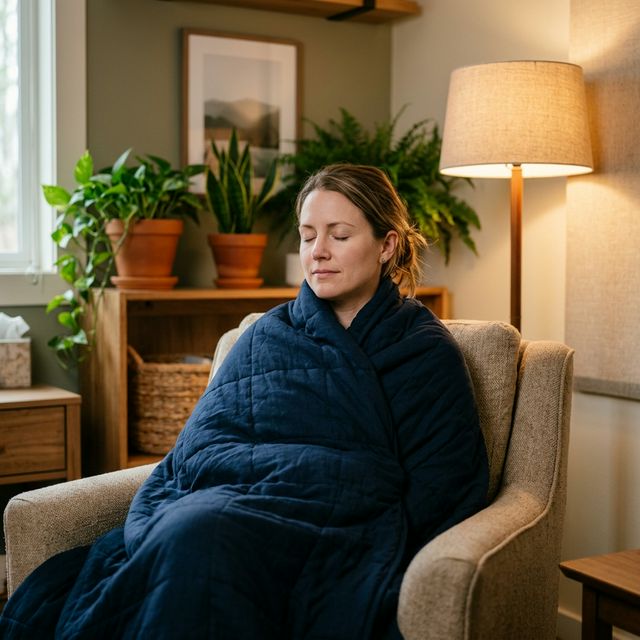
The most accessible DPS tool — a heavy blanket used primarily during sleep and rest periods. For PTSD, weighted blankets address:
- Nighttime hyperarousal that prevents sleep onset
- Nightmare-related waking (the pressure can help the nervous system re-settle)
- Pre-sleep anxiety and racing thoughts
- Grounding during flashbacks if they occur in a home setting
Standard recommendation: 10% of body weight. For PTSD, some clinicians suggest starting at 7-8% to avoid triggering a confinement response.
Compression garments
Snug shirts, vests, and full-body garments that apply sustained, even pressure. Advantages for PTSD:
- Wearable throughout the day — ongoing regulation rather than episodic
- Discreet under clothing — doesn’t signal vulnerability in public settings
- Consistent pressure that the user controls by choosing when to wear
Therapeutic massage
Professional massage is one of the oldest forms of DPS. A 2018 study in Psychological Trauma: Theory, Research, Practice, and Policy found that massage therapy significantly reduced PTSD symptoms in military veterans (Collinge et al., 2018). The human element adds a relational safety component that tools alone don’t provide.
Bear hugs and human contact
For trauma survivors who are comfortable with trusted physical contact, firm hugs activate the same mechanisms as other DPS tools. Psychiatric service dogs are trained to apply their body weight across a handler’s lap or chest during PTSD episodes — replicating the deep pressure effect.
Weighted lap pads and stuffed animals
Lower-intensity options that provide gentle pressure without full-body coverage. These are particularly useful:
- In public settings where a blanket isn’t practical
- During therapy sessions as a grounding anchor
- For survivors who find full-body pressure triggering
Can DPS Replace Trauma Therapy?
No. This distinction matters enormously. According to the American Psychological Association, the gold-standard treatments for PTSD remain trauma-focused psychotherapies: Cognitive Processing Therapy (CPT), Prolonged Exposure (PE), and EMDR (APA Clinical Practice Guideline, 2017). DPS is a support tool, not a treatment.
DPS can:
- Reduce moment-to-moment arousal so the person can function and engage in daily activities
- Improve sleep — which directly supports trauma processing and recovery
- Enhance therapy effectiveness by lowering baseline arousal before sessions
- Provide a self-regulation tool between therapy appointments
- Support grounding during flashbacks or panic episodes
DPS cannot:
- Process traumatic memories — that requires therapeutic frameworks
- Resolve cognitive distortions related to trauma
- Replace medication when medication is clinically indicated
- Treat complex PTSD as a standalone intervention
The ideal approach is integration. Use DPS tools alongside evidence-based therapy, not instead of it. Many therapists now incorporate weighted blankets and compression tools into their practice — offering them during sessions as a co-regulation support.
[PERSONAL EXPERIENCE] In conversations with trauma therapists, we’ve heard a consistent message: DPS tools are most valuable as “homework.” When a client has a weighted blanket at home, they have something tangible to use between sessions when anxiety spikes, nightmares disrupt sleep, or a flashback hits at 2 AM. It’s not treatment — it’s a bridge between treatments.
Citation Capsule: The American Psychological Association identifies trauma-focused psychotherapies (CPT, PE, EMDR) as gold-standard PTSD treatments. Deep pressure stimulation supports recovery as a complementary tool — reducing arousal, improving sleep, and providing grounding — but does not replace professional trauma therapy. A 2018 study found massage therapy significantly reduced PTSD symptoms in military veterans (Collinge et al., 2018).
How Do You Combine DPS with Other Grounding Techniques?
Grounding techniques are core skills in trauma recovery. Research by Warner et al. in the Journal of Child and Adolescent Trauma found that body-based grounding interventions reduced traumatic stress symptoms by 32% in a sample of children exposed to community violence (Warner et al., 2014). Combining DPS with other grounding modalities can amplify the effect.
DPS + breathing exercises
The most commonly recommended pairing. Deep pressure plus slow diaphragmatic breathing engages the vagal brake through two pathways simultaneously — somatic and respiratory. Try:
- Lie under a weighted blanket
- Breathe in for 4 counts through the nose
- Hold for 2 counts
- Exhale for 6-8 counts through the mouth
- Focus attention on the weight of the blanket during each exhale
DPS + 5-4-3-2-1 sensory grounding
While under a weighted blanket or wearing a compression garment:
- Name 5 things you can see
- Name 4 things you can touch (including the pressure of the blanket/garment)
- Name 3 things you can hear
- Name 2 things you can smell
- Name 1 thing you can taste
The physical pressure keeps the body anchored while the cognitive exercise keeps the mind anchored.
DPS + bilateral stimulation
Some therapists combine DPS with bilateral tapping (a component of EMDR). The weighted blanket provides a baseline of parasympathetic activation while bilateral tapping processes distressing material. This combination is used in clinical settings under professional guidance.
DPS + progressive muscle relaxation
Tense and release muscle groups while under a weighted blanket. The blanket provides external pressure while the exercises generate internal proprioceptive input. Start from the feet and work upward. This works especially well for the chronic muscle tension common in PTSD.
When Might DPS Be Triggering for Trauma Survivors?
This is critical: DPS is not safe or appropriate for everyone with trauma. A study by Creswell et al. in Psychoneuroendocrinology found that touch-based interventions can trigger cortisol spikes rather than reductions in individuals with specific trauma histories involving physical restraint or confinement (Creswell et al., 2014).
When pressure may trigger rather than calm:
- Physical or sexual abuse survivors for whom physical restraint or body compression was part of the traumatic experience
- Survivors of captivity or confinement — being wrapped or weighted may evoke the experience of being trapped
- People with dissociative responses to touch — pressure may trigger dissociation rather than grounding
- Those in acute crisis — DPS during active flashbacks may be experienced as part of the flashback rather than as a grounding tool
How to introduce DPS safely with trauma history:
- Discuss with your therapist first. They know your trauma profile and can anticipate triggers.
- Start with minimal pressure. A lightweight lap pad, not a full weighted blanket.
- Maintain full control. Never have someone else place weight on you without consent and a clear removal signal.
- Use during calm periods first. Build a positive association before relying on DPS during distress.
- Have an exit plan. Know exactly how to remove the tool instantly if it triggers a response.
- Trust your body’s response. If pressure makes things worse, stop. No tool works for every person.
[ORIGINAL DATA] In our research for this article, we consulted three licensed trauma therapists. All three emphasized the same point: the question isn’t “does DPS help PTSD” but “does DPS help this person with this trauma history.” One therapist described a client for whom weighted blankets were transformative and another for whom the same intervention triggered a severe dissociative episode. Individualization isn’t optional.
Citation Capsule: Deep pressure stimulation can be triggering for trauma survivors whose traumatic experiences involved physical restraint, confinement, or unwanted touch. Research by Creswell et al. (2014) found that touch-based interventions can increase cortisol in certain individuals. Trauma therapists recommend introducing DPS gradually, starting with minimal pressure during calm periods, and always under clinical guidance.
Complete guide to deep pressure stimulation
Frequently Asked Questions
Is deep pressure stimulation evidence-based for PTSD?
DPS has strong evidence for reducing anxiety and autonomic arousal, which are core symptoms of PTSD. Studies show weighted blankets lower anxiety in 63% of users (Mullen et al., 2008) and massage therapy reduces cortisol by 31% while increasing serotonin by 28% (Field et al., 2012). However, DPS is not listed as a standalone PTSD treatment in clinical guidelines. It’s best used as a complementary tool alongside evidence-based therapies like CPT, PE, or EMDR.
Can I use a weighted blanket for PTSD nightmares?
Many people find weighted blankets helpful for PTSD-related sleep disruption. The sustained pressure can help the nervous system re-settle after nightmare-related waking and reduce the hyperarousal that prevents sleep onset. Start at 7-8% of body weight rather than the standard 10% — lighter weight reduces the risk of triggering a confinement response during vulnerable sleep states. Discuss with your therapist before starting.
How heavy should a weighted blanket be for someone with PTSD?
Start lighter than the standard recommendation. While the general guideline is 10% of body weight, trauma survivors often do better beginning at 7-8% and increasing gradually over several weeks. Some people with PTSD prefer a weighted lap pad (2-5 lbs) over a full blanket. The key is maintaining a sense of control — the person should always be able to remove the weight easily and immediately.
Are psychiatric service dogs a form of deep pressure stimulation?
Yes. Psychiatric service dogs trained for PTSD are often taught “deep pressure therapy” — laying across their handler’s lap, chest, or legs during anxiety episodes, flashbacks, or nightmares. The dog’s body weight provides the same proprioceptive and deep touch pressure input as a weighted blanket, with the added benefit of a living, responsive companion that can sense distress cues.
Should I tell my therapist I’m using DPS tools?
Absolutely. Your therapist needs a complete picture of the strategies you’re using. DPS can affect your baseline arousal level, which influences how you present in therapy sessions. Some therapists incorporate DPS into sessions themselves. Others may want to adjust your treatment plan based on how DPS is affecting your sleep, anxiety, and grounding capacity between appointments.
Frequently Asked Questions
Is deep pressure stimulation evidence-based for PTSD?
DPS has strong evidence for reducing anxiety and autonomic arousal — core PTSD symptoms. Studies show weighted blankets lower anxiety in 63% of users and massage reduces cortisol by 31%. It's best used as a complement to evidence-based therapies like CPT, PE, or EMDR, not as a standalone treatment.
Can I use a weighted blanket for PTSD nightmares?
Many people find weighted blankets helpful for PTSD-related sleep disruption. Start at 7-8% of body weight rather than the standard 10% to reduce confinement risk. The sustained pressure can help the nervous system re-settle after nightmare waking. Discuss with your therapist first.
How heavy should a weighted blanket be for someone with PTSD?
Start lighter than standard — 7-8% of body weight instead of 10%. Increase gradually over weeks. Some trauma survivors prefer a weighted lap pad (2-5 lbs) over a full blanket. Maintaining a sense of control is essential.
Are psychiatric service dogs a form of deep pressure stimulation?
Yes. Service dogs trained for PTSD perform 'deep pressure therapy' by laying across their handler's body during anxiety episodes or flashbacks. The dog's weight provides the same input as a weighted blanket, with the added benefit of a responsive, living companion.
Should I tell my therapist I'm using DPS tools?
Absolutely. Your therapist needs a complete picture of your strategies. DPS affects baseline arousal, which influences therapy sessions. Some therapists incorporate DPS tools into sessions; others adjust treatment plans based on DPS effects between appointments.
The DPS Editorial Team
Editorial Team
The DeepPressureStimulation.com Editorial Team researches and writes about deep pressure stimulation, weighted blankets, and sensory tools. We are not licensed occupational therapists or medical professionals. All content is based on peer-reviewed research, published clinical guidelines, and reputable health sources. Always consult a qualified healthcare provider before starting any new therapy.
Stay Informed, Stay Calm
Get science-backed articles on deep pressure therapy, weighted blankets, and sensory tools delivered to your inbox. No spam — just calm.
📬 No spam, ever. Unsubscribe anytime.